Watch
A. Lange & Söhne Unveils Downsized Saxonia Annual Calendar with Enhanced Movement

A. Lange & Söhne has introduced a significant update to its classic Saxonia Annual Calendar, echoing a recent trend towards more compact watch designs. Following the pattern set by the 34mm 1815 models last year, the Saxonia Annual Calendar now features a reduced case size and an entirely new internal mechanism. This marks the first major overhaul for the model in over fifteen years, bringing a fresh perspective to a beloved timepiece. The changes aim to enhance both wearability and functionality, appealing to both long-time enthusiasts and new collectors.
For more than a decade and a half, the Saxonia Annual Calendar was characterized by its 38.5mm case. The latest iteration, however, is presented in a more modest 36mm size, available in either elegant white or rose gold. This reduction in diameter promises a distinct on-wrist sensation, offering a more understated presence. Despite the smaller case, the watch maintains its 9.8mm thickness, which, while still svelte for an automatic timepiece, implies that the vertical dimensions remain consistent with its larger predecessor. A new functional addition is a discreet corrector located at the 10 o'clock position, allowing for the simultaneous adjustment of all calendar functions. This feature greatly simplifies the process of setting the watch, particularly during monthly transitions not automatically managed by the movement, such as the shift from February to March.
The aesthetic refinements of the dial are subtle yet impactful. Offered in either a sophisticated silver or deep dark grey, the dial is adorned with markers and hands that complement the chosen case material—white or rose gold. A notable artistic upgrade is the moon phase display, which now showcases a more intricate and varied array of stars, creating a dense, almost Milky Way-like visual effect. This artistic enhancement adds a layer of beauty to the otherwise clean and functional dial. Furthermore, the subdials have been redesigned, transitioning from a stepped configuration to a more gently sloping, 'pie-pan' topography. The outer rings of these subdials feature a finer grooving, introducing a subtle contrast. The iconic large date display retains its prominent position at 12 o'clock, and Lange’s characteristic lance-style hands are consistently used throughout the design.
The most substantial innovation in the 36mm Saxonia Annual Calendar lies within its movement, which is visible through the sapphire caseback. The original L085.1 movement featured a microrotor and a power reserve of 48 hours. The new L207.1 caliber represents a significant leap forward, utilizing a full-sized rose gold rotor with a platinum mass to optimize inertia. This new movement extends the power reserve to an impressive 60 hours, operating at 21,600 vibrations per hour when fully wound. As expected from A. Lange & Söhne, the balance cock is meticulously hand-filigreed, supporting the swan neck regulator. In true German watchmaking tradition, the movement incorporates a 3/4 plate crafted from German silver, lending a warm hue that beautifully contrasts with the white gold casing. While it's unclear if this new caliber includes Lange's signature zero-reset mechanism, the introduction of the single-pusher correction mechanism is a practical improvement, significantly simplifying adjustments compared to the previous method of using individual pin-push correctors.
In a period where some brands are venturing into larger timepieces, A. Lange & Söhne demonstrates a clear commitment to the trend of miniaturization with the Saxonia Annual Calendar. Although the 36mm size might be considered compact by certain preferences, it generally garners widespread acceptance and enthusiasm in today's market. With its refined movement and updated features, this new model stands as an enhanced successor to its forerunner. The A. Lange & Söhne Saxonia Annual Calendar is available in both pink gold (model 331.033 E) and white gold (model 331.026 E), each priced at €65,000 EUR.
Other Articles
 Apr 14, 2026
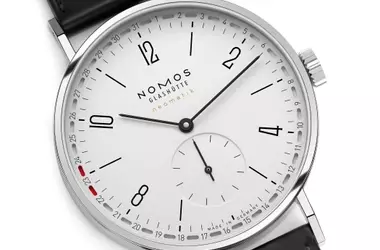
Nomos Glashütte Unveils New Tangente Neomatik 38 Update
Nomos Glashütte introduces a refined version of its Tangente Neomatik Update at Watches and Wonders 2026, now in a more compact 38.5mm case. This elegant dress watch maintains its iconic Bauhaus design and innovative peripheral date display, while offering both stainless steel and luxurious 18k gold options. Powered by the ultra-thin DUW 6101 automatic movement, the new model promises enhanced wearability and broader appeal.
 Apr 14, 2026
Jaeger-LeCoultre Unveils Revolutionary Triple-Axis Tourbillon Watch
Jaeger-LeCoultre introduces the Master Hybris Inventiva Gyrotourbillon à Stratosphère, a pinnacle of mechanical watchmaking. This limited edition platinum timepiece features a groundbreaking triple-axis tourbillon, boasting an unprecedented 98% positional coverage for superior precision. It represents the brand's relentless pursuit of innovation, joining the esteemed Hybris family with its unique focus on single, complex complications.
 Apr 14, 2026
IWC Debuts Pilot's Venturer Vertical Drive: A Watch Engineered for Space Exploration
IWC has unveiled the Pilot's Venturer Vertical Drive, a groundbreaking timepiece designed explicitly for space travel in collaboration with Vast, a company building the first commercial space station. This watch, reference IW328601, marks IWC's deliberate entry into space-specific watchmaking, moving beyond its traditional aviation heritage. It features a unique patent-pending rotating bezel system for full functionality control, catering to astronauts wearing thick gloves during spacewalks. The watch boasts a new IWC-manufactured 32722 caliber, advanced materials like ceramic and Ceratanium, and a specialized 24-hour time display for orbital environments, symbolizing humanity's renewed interest in cosmic exploration.