Watch
The Perceived Value and Practicality of Perpetual Calendar Watches

This discussion delves into the perplexing allure of perpetual calendar timepieces, often seen as the pinnacle of horological achievement. However, a critical examination reveals that their practical utility might be overshadowed by their intricate mechanics and significant price tags. While these watches showcase remarkable engineering, their tangible benefits in daily use, especially for multi-watch owners, appear limited when compared to simpler, more accessible alternatives. The debate centers on whether the value of such a sophisticated complication truly lies in its function or in its status as a symbol of haute horlogerie.
Calendar watches come in various forms, each offering differing levels of date management. The basic calendar handles month-end adjustments for 31-day months. The annual calendar automates most monthly changes, with the notable exception of February transitioning to March, requiring a manual adjustment once a year. The perpetual calendar, however, is designed to manage every monthly transition, including leap years, supposedly removing the need for manual date corrections. Yet, the true 'advantage' often boils down to avoiding a single manual adjustment in March. This seemingly minor convenience comes at a substantial cost premium; for instance, a Patek Philippe perpetual calendar can command significantly more than its annual calendar counterpart, despite the latter sometimes featuring luxurious embellishments like diamonds. This disparity raises questions about the genuine value proposition of the perpetual complication.
Beyond functionality, the aesthetic presentation of perpetual calendars is a recurring point of contention. Many brands opt to display every possible indication—day, date, month, moon phase, and even year—leading to cluttered and sometimes illegible dials. While some manufacturers, like Moser, have demonstrated that such complications can be integrated with minimalist designs, the prevailing trend leans towards showcasing the complexity, often at the expense of readability. This design philosophy further complicates the argument for practicality, as the primary purpose of a watch—telling time and date—can be obscured by an abundance of information, with the most crucial detail, the date, becoming just one element among many.
A key observation is that owners of mechanical perpetual calendars rarely possess only one timepiece. It's a reasonable assumption that these collectors own multiple watches, many of which likely feature standard date functions requiring occasional manual adjustments. Consequently, these individuals are already accustomed to the routine of setting a watch's date. This challenges the notion that the perpetual complication offers a significant convenience, as the act of manual correction is not an unfamiliar task for this demographic. Thus, the practical benefit of a perpetual calendar in preventing a single annual adjustment seems negligible in the context of a collector's habits.
In essence, perpetual calendars, much like repeaters or tourbillons, often serve as indicators of status and a testament to traditional watchmaking artistry rather than indispensable tools for convenience. While other high complications might offer unique experiences like auditory chimes or mesmerizing movements, the perpetual calendar's primary 'benefit' is often the avoidance of a minor annual adjustment. This leads to the conclusion that for many, the appeal of a perpetual calendar lies not in its everyday utility, but in the appreciation of its mechanical ingenuity and its position as a symbol within the hierarchical world of luxury timepieces.
Other Articles
 Mar 01, 2026
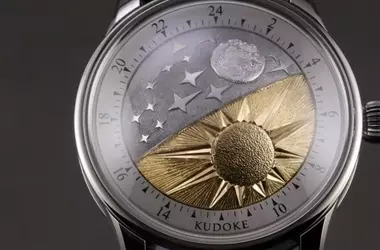
Kudoke 5: A Fusion of Art and Horological Innovation
The Kudoke 5 watch offers a unique blend of artistic design and innovative time display. Featuring a dramatically domed crystal and an intricately engraved rotating disk showing day and night, this timepiece challenges traditional watchmaking. Its hand-finished movement and customization options underscore its commitment to high-end independent craftsmanship, making it a true collector's item.
 Mar 01, 2026
Vintage-Inspired Divers: Favre Leuba Deep Raider Revival vs. Aquastar Deepstar II
This article compares two contemporary dive watches, the Favre Leuba Deep Raider Revival and the Aquastar Deepstar II, both drawing inspiration from their brands' 1960s heritage. While the Deep Raider Revival is a direct modernization of a classic, the Deepstar II reimagines a chronograph design into a time-only piece. Both watches offer unique aesthetics and modern specifications, prompting a debate over which vintage-inspired diver is superior.
 Mar 01, 2026
Win an Astor+Banks Fortitude Pro Mint Green Timepiece
Enter for a chance to win the exquisite Astor+Banks Fortitude Pro Mint Green watch, a sophisticated timepiece combining classic design with a refreshing color. This 38.5mm stainless steel watch features a scratch-resistant coating, 200m water resistance, and a precise Miyota 9015 automatic movement, making it ideal for both elegance and daily wear. Participate in this exclusive giveaway to add a touch of springtime flair to your collection.